Showing posts with label Books and Films. Show all posts

Sunday, December 31, 2017

Saving Fish from Drowning


So, the premise is that 12 travelers to Myanmar, formerly known as Burma, go missing and a perusal of all the details that accompany that fact. At first, I thought this book was a disappointment after Tan fare like The Joy Luck Club and the Kitchen God's Wife. Nonetheless, Tan, true to literary style, enchants with cultural, political and other engaging details and even outdoes herself with the most outstanding character development I have ever read of each of the characters. In all honesty, I was a bit bored until about midway through the novel when I became hooked with the mini-drama of each person's life and realized I was reading a television reality show, aka Survivor, but creatively told from the viewpoint of the deceased original Chinese tour guide, Bibi Chen's ghost.

Did I mention that this book is also chock full of great quotes, life reflections and philosophical quips? Here are some of my favorites:

“The only thing certain in times of great uncertainty is that people will behave with great strength or weakness, and with very little else in between.”


“From what I have observed, when the anaesthesia of love wears off, there is always the pain of consequences. You don't have to be stupid to marry the wrong man.” 


"What bloody good was human adaptability if people weren't willing to change? Wasn't that why no penal system really worked to prevent crime, why people went to psychiatrists for years eithout any intentions of overcoming their obsessions and depressions? Humans had this extraordinary fondness for their own peccadilloes. That's why you could't change a Republican into a Democrat and vice versa, why there were so many divorces, lawsuit, and wars. Because people refused to adapt and accommodate to others even for their own good!" p243

“There is a famous Chinese sentiment about finding the outer edges of beauty. My father once recited it to me: 'Go to the edge of the lake and watch the mist rise... At dawn, the mist rose like the lake's breath, and the vaporous mountains behind faded in layers of lighter and lighter gray, mauve, and blue until the farthest reaches merged with the milky sky...Here the lessons of Buddha seemed true, she thought. Life was merely an illusion you must release. As she grew older, she was aware of her changing position on mortality. In her youth, the topic of death was philosophical; in her thirties it was unbearable and in her forties unavoidable. In her fifties, she had dealt with it in more rational terms, arranging her last testament, itemizing assets and heirlooms, spelling out the organ donation, detailing the exact words for her living will. Now, in her sixties, she was back to being philosophical. Death was not a loss of life, but the culmination of a series of releases. It was devolving into less and less. You had to release yourself from vanity, desire, ambition, suffering, and frustration - all the accoutrements of the I, the ego. And if you die, you would disappear, leave no trace, evaporate into nothingness...” pp228-9


Amy Tan, Saving Fish from Drowning

Saturday, December 23, 2017

Letters from Father Christmas


Posing as Father Christmas, Tolkien wrote letters for over twenty years to his children, John, Michael, Christopher and Priscilla. Almost every letter is a juvenile literature classic with plots and subplots, characters, instructions and advice.


It's impossible not to fall in love with NPB, North Polar Bear, and his downfalls and antics, and the humorous interplay between him and Father Christmas, both writing their own versions of incidents, mostly at the North Pole. There are delightful moments like NPB getting stuck in the snow, developing the whooping cough and barking like bears on Boxing Day, and how FC talks about with the right organisation you can get about 1000 stockings a minute done. He also gives insight to his character and fatherly sense of level-headed justice. "I don't forget people, even when they're past stocking age, not until they forget me."


There are snowboys, the children of snowmen, of course, and all kinds of magic, which Tolkien says, is strongest at Christmas.
Finally, the illustrations, which are also Tolkien's handiwork, are a treasure in and of themselves.

A highly recommendable read, but one to take slowly, maybe starting right after Thanksgiving and reading a bit every day to savour it all.

Monday, November 13, 2017

Agradecimiento


Thankful!

The magical moment my students saw their beautiful melted crayon and leaf stained glass art against the light,

Finding a treasure today, my favorite bedtime tea in León, Spain, which I'm sipping as I write,

Going out for tapas and little beers with my wonderful friend and partner in lifes' joys and challenges,

Reading "Patria" together, a gripping Spanish novel and birthday gift from my literature students.
Many more blessings, but that's a start.

Sunday, October 15, 2017

Catalonia, Too Much, Said the Fish

What's does a Fish have to do with the separatist movement  in Catalonia? Well, it's a fairy tale about a magical fish and a Catalonian government that every time wants more and more from Spain. While the outcome surely won't be the same, the demands and expectations of Spain's most prosperous province sound much too similar. First, you'll have to have read the Grimm Brother's Tale of The Fisherman and his Wife to understand what I'm going to write next.

¿Qué tiene que ver el Pez de la fábula con el movimiento separatista de Cataluña? Bueno, hay un cuento de hadas sobre un pez mágico que concede deseos y alguien que siempre quiere más, como el gobierno de Cataluña respecto de España. Si bien el resultado seguramente no será el mismo, las exigencias y expectativas de la región más próspera de España son muy similares. Primero, tendrás que haber leído el Cuento de Grimm "El Pescador y su Esposa" para entender lo que voy a escribir a continuación.

Thursday, August 31, 2017

Season

Advanced Literature class in Spain, in Academia La Cocina Verde, getting ready for an excellent read a year ago. Now, fall just around the corner, we've read our way through season by season.
Just like excellent poetry, this isn't a book to be read from cover-to-cover, but rather savoured throughout the year, reading each entry like a delicious tidbit in its season, hence the well-named title. I love this prose. It as though I'm playing while reading, dancing between the lines and then lingering here and there to drink up the visual flavours and imagery of almost every word and phrase. 

Imagine this: 
"The sky seems like a watercolor love story." - Fireflies

"The air smells like spring seduced late summer and drenched the night in promises. Somewhere between possibility and substance, the evening hovers, a strange shade of autumn....
Amazing...astounding what fifteen minutes surrounded by the throb of another's heart can do for the equilibrium of a soul. Storms arrive and abate. The planet spins. And hearts beat." -
Heartbeat
Or

"End-of-summer rain traces the outline of the window panes next to me; damp trails glimmering beneath the slate clouds that seem to hover close enough to touch, should I stretch out my hand." 
-Blurred

"For that is the secret, isn't it. No matter how deep the pain, how unbearable it seems as it scrapes and tears and breaks our bodies, our dreams... our souls. No matter the wound, there is the balm of time. The bandage of memory, the antiseptic of grace." - Burns

I relish the Soup. It revives me, reminds me that the world is made of flesh and breath, not manufactured compounds (like that from a can) and synthetic fibers... For the truth of the Soup, the revelation, is that if you wait until 'it' is done - whatever your 'it' may be - you will miss out on the authentic happiness that is 'now'. We all have scuff and brokens and imperfects... but this is exactly what ties us together!" - Soup Afterglow


"We live, we love. We laugh and grieve and learn and grow. Life is a forge that burns away the surface, strengthens the core, and reveals the soul. This collection of essays and memories plunges through more than a decade of the beautiful struggle that is marriage and parenthood and finding one's self amidst the tangle of both. This journey weaves joy and sorrow, passion as well as isolation, into a tapestry that makes such an ordinary life, more splendid than its solitary threads."

Sunday, July 9, 2017

A Book of Beauty


"...The hours when the mind is absorbed by beauty are the only hours when we really live..." - Richard Jefferies
A Book of Beauty; An Anthology of Words and Pictures, compiled in London ten years before I was born. Two hundred and fifty classic works of art and illustrations and a two-page index of authors and composers, it appears this is one of a series of six books; Book of Delights, Love, Pleasures, Joy, and of Britain. A lovely gift by a lovely visitor, it was once purchased and signed by someone with exquisite penmanship in 1962 as a Christmas present to herself, something that makes me smile and further endears this book to me. The perfect bedside book.
#vintageprints #vintagebooks #JohnHadfield #beauty #london#Wordsworth #Yeats #tselliot #Browning #Shelley #FrancisBacon #poetry#prose

Sunday, May 28, 2017

Kundera and The Unbearable Lightness of Being

All photos from walking tour of Bilbao, País Vasco - Basque Country 
At another time in my life I would have cringed to reference Sparknotes and Wikipedia in a book or film critique, but since the subject is so weighty, with philosophical quotes and dealings of the ancients, I gave myself full license this time. Not to mention the most insightful critique of all I found, written by Reason and Meaning; Philosophical reflections about life, death, and the meaning of life.
Regarding my own commentary, be sure to read to the end to understand why after discussions and political debate I ended up wondering how much Kundera plays devil's advocate and toys with his reader, and found his book to be a classic in philosophical thought regarding the meaning of life.


The Unbearable Lightness of Being opens with a philosophical discussion of lightness versus heaviness. Kundera contrasts Nietzsche's philosophy of eternal return, or of heaviness, with Parmenides's understanding of life as light. Kundera wonders if any meaning or weight can be attributed to life, since there is no eternal return: if man only has the opportunity to try one path, to make one decision, he cannot return to take a different path, and then compare the two lives. Without the ability to compare lives, Kundera argues, we cannot find meaning; where meaning should exist we find only an unbearable weightlessness. The uncertain existence of meaning, and the opposition of lightness and heaviness, the key dichotomy of The Unbearable Lightness of Being, sets the stage for the entire novel.
- Sparknotes


Kundera uses Friedrich Nietzsche's doctrine of the Eternal Return to illustrate Lightness. Eternal Return dictates that all things in existence recur over and over again for all eternity. This is to say that human history is a preset circle without progress, the same events arising perpetually and doomed never to alter or to improve. Existence is thus weighty because it stands fixed in an infinite cycle. This weightiness is “the heaviest of burdens”, for “if every second of our lives recurs an infinite number of times, we are nailed to eternity as Jesus Christ was nailed to the cross.” At the same time, it is necessary for any event to occur in the cycle of events exactly as it has always occurred for the cycle to be identical; consequently, everything takes on an eternally fixed meaning. This fact prevents one from believing things to be fleeting and worthless.

The inverse of this concept is Kundera's “unbearable lightness of being.” Assuming that eternal return were impossible, humankind would experience an “absolute absence of burden,” and this would “[cause] man to be lighter than air” in his lack of weight of meaning. Something which does not forever recur has its brief existence, and, once it is complete, the universe goes on existing, utterly indifferent to the completed phenomenon. “Life which disappears once and for all, which does not return” writes Kundera, is “without weight...and whether it was horrible, beautiful, or sublime...means nothing.” Each life is insignificant; every decision does not matter. Since decisions do not matter, they are "light": they do not tie us down. However, at the same time, the insignificance of our decisions - our lives, or being - is unbearable. Hence, "the unbearable lightness of being." On the other hand, eternal existence would demand of us strict adherence to prescripted rules and laws; a sense of duty and rigorous morality.

"What then shall we choose? Weight or lightness?" Kundera notes that this is not a new question. Parmenides posed it in the sixth century BC. He saw the world divided into pairs of opposites: light/darkness, fineness/coarseness etc. One half of the opposition he called positive (light, fineness, warmth, being), the other negative. We might find this division into positive and negative poles simple except for one difficulty: which one is positive, weight or lightness? Parmenides responded that lightness is positive, weight negative. Kundera then questions "Was he correct or not?" The lightness/weight opposition remains the most ambiguous of all. Kundera then asks, should one live with weight and duty or with lightness and freedom? In Nietzschean terms, weight is life-affirming in that to live with positive intensity is to live in a way you'd be prepared to repeat. The emptiness of Sabina's life in 'The Unbearable Lightness Of Being', and that she wanted to "die in lightness" — which is to say that she is indifferent to her life — shows that she would not want to repeat her life and would not accept an eternal return. - Opinion piece, Wikipedia


While some might find Tomas' sexual appetite and exploits edgy, daring or on the contrary, maybe even repulsive, I became bored and tired quickly of them. By the end I found his going-ons really unpleasant and distasteful, maybe even as much as Tereza and maybe because of her. I suppose this is due to two reasons. One, I abhor waste and wastefulness and experiencing sex in such consumeristic excess is a total throw away of possibilities, of feelings, loyalties, personalities, friendships, all qualities of humanity and even basic decency. Secondly, said consumerism is entirely void of any nobler or higher emotion. This isn't something to be argued. Maybe for some it's fine, but it's not my idea of anything valuable in life.  The plot, in and of itself, therefore, didn't provide a great read.

What I did find thought provoking and worthwhile was the philosophical journey and even certain application of Nietzsche's premise and its inverse. In Milan Kundera's work we delve into the the study of how life can't have meaning if we're unable to study it from the far end. In other words, if we can't study our lives looking backwards, from the point of view of our death. Instead, in real time, when we must make our most important decisions how can we absolutely know if they are right and wrong if we can never practice what it is to choose well for ourselves, and what choices could be bad and even disastrous? How, therefore, can morality be attached to our choices? This is the deeper, more meaningful essence and redemptive element of the novel. It poses questions about the heaviness and lightness of life. And in the end, many, myself included might decide that while lightness, or lives free as the air we breathe, might be tempting, it might not be the most desirous choice after all. We might decide the light is insignificant, void of meaning and decide that it's simply unbearable and choose heaviness, together with meaning and purpose, instead. Still, in conclusion, not I, nor most lectors will be able to answer simply by the end of this read. That's what gives this book cause for deeper reflection and true value.

Saturday, March 18, 2017

Intimidad


Intimacy
(She)" says that the art of reading is slowly dying, that it's an intimate ritual, that a book is a mirror that offers us only what we already carry inside us, that when read, we do it with all our heat and mind, and great readers are becoming more scarce by the day."

(Ella) " dice que el arte de leer se está muriendo muy lentamente, que es un ritual íntimo, y que un libro es un espejo y que sólo podemos encontrar en él lo que ya llevamos dentro, que al leer ponemos la mente y el alma, y que esos son bienes cada día más escasos."
#reread #betterthesecondtime #original #inSpanish #goodnight #habits#intimacy #lecturas #literatura #libros #bibliofilia #bibliophiles#shadowofthewind #lasombradelviento #ruizzafon #literaturelover

Enrique: He aquí una escena de cama con mi esposa, practicando un ritual íntimo, como dice el texto. ¡Qué felicidad!

Monday, February 27, 2017

Just Read

"Si no leemos no sabemos escribir y si no sabemos escribir no sabemos pensar."
If we don't read we don't know how to write and if we don't know how to write we don't know how to think.


“The best way to learn about books," he said, "is to spend time with them, talk about them, defend them.”
Charlie Lovett, The Bookman’s Tale


Today I finished The Bookman's Tale. It came as quite a surprise to me that the author, Charlie Lovett, had found a way to court me and all bibliophiles with his literary style, replete with antique bookshops, ancient manuscripts, marginalia (a thing I knew about, but for which I didn't know there was a term), literary artefacts and forgeries. His writing is so enmeshed in the world of books that I was also compelled to read several biographies on Lovett, something I rarely do, and discovered that much like his characters, his own world as the son of  has been one immersed in the love of books since his birth. 

The main character of The Bookman's Tale is a young antiquarian bookseller who relocates from the Coast of North Carolina to the English Countryside, where he can become absorbed in collecting and restoring rare books to overcome a deep personal grief.

"Peter did not want to know people. What he wanted was to find that world-within-the-world where he could be himself by himself...
Peter discovered exactly what would protect him: books."

"He closed his eyes for a moment, imagining the cocoon of books, shielding him from all danger, inhaling deeply that familiar scent of cloth and leather and dust and words. His rushing pulse began to slow, and when he opened his eyes he scanned the shelves for something familiar - a title, an author, a well-remembered dust jacket design - anything that might ground him in the world of the known."


A couple of teasers: 
After the death of his wife, Peter Byerly, a young antiquarian bookseller, relocates from the States to the English countryside, where he hopes to rediscover the joys of life through his passion for collecting and restoring rare books. But when he opens an eighteenth-century study on Shakespeare forgeries, he is shocked to find a Victorian portrait strikingly similar to his wife tumble out of its pages, and becomes obsessed with tracking down its origins. As he follows the trail back to the nineteenth century and then to Shakespeare's time, Peter learns the truth about his own past and unearths a book that might prove that Shakespeare was indeed the author of all his plays.
&
A mysterious portrait ignites an antiquarian bookseller’s search through time and the works of Shakespeare for his lost love.
Hay-on-Wye, 1995. Peter Byerly isn’t sure what drew him into this particular bookshop. Nine months earlier, the death of his beloved wife, Amanda, had left him shattered. The young antiquarian bookseller relocated from North Carolina to the English countryside, hoping to rediscover the joy he once took in collecting and restoring rare books. But upon opening an eighteenth-century study of Shakespeare forgeries, Peter is shocked when a portrait of Amanda tumbles out of its pages. Of course, it isn’t really her. The watercolor is clearly Victorian. Yet the resemblance is uncanny, and Peter becomes obsessed with learning the picture’s origins.
As he follows the trail back first to the Victorian era and then to Shakespeare’s time, Peter communes with Amanda’s spirit, learns the truth about his own past, and discovers a book that might definitively prove Shakespeare was, indeed, the author of all his plays.

Lovett dedicates The Bookman's Tale to his father, who, as he says, "infected me with an incurable bibliomania." The Bookman's Tale is one of knowledgeable study of collectable manuscripts, original texts, inking, printing methods and more. It has intrigue, love, passions, deceit, arrogance, murder and more. It has everything of which a successful novel can boast, but yet is confined to the interests of a bookish elite, making this novel one set apart for a particular genre, book lovers, the same readers as those who adore Zafan's, The Shadow of the Wind, A.S. Byatt’s Possession and all the other texts whose tales are spun around the written word.


Friday, February 10, 2017

Fifty Shades Darker

We get one movie per week in our little town, this one, showing now through Valentine's Day.
"Most women who meet real-life Christian Greys end up battered or in graveyards...women can put up with a lot of crap hoping things will change, but especially when it comes to real relationships with abusive partners, romance and an abuse-sympathizing plot are a really bad combination. Fifty Shades sells it as a good thing." 

When the 'Fifty Shades Darker' Ads Give You Disturbing Flashbacks You Know Something's Wrong.

Women are beaten and die every single day in domestic violence cases. I, for one, with my own suitcase of relational abuse baggage, am not going to spend one dime toward this kind of twisted misogynistic message.

Friday, December 9, 2016

Hasa el Último Hombre

Hasta el Último Hombre - Altamente recomendada.
Normalmente evito películas de guerra y su sangre y violencia como a la peste. Nunca me verás viendo Platoon, La Colina de la Hamburguesa (Hamburger Hill) y me costó mucho ver Salvar al Soldado Ryan. Pero, Hasta el Último Hombre, una historia verdadera de un pacifista que quería servir a su país y salvar vidas, realmente vale la pena.


Una entrada que ha hecho Enrique.

Thursday, November 10, 2016

El Gato Maragato


La leyenda del gato maragato

Todo empieza "bajo la protección de una mágica y vetusta encina en el pueblo maragato de Castrillo de los Polvazares," que está cerca de Astorga y a donde hemos ido con mucha frecuencia, haciéndolo muy nuestro. Así, esta historia me resulta entrañable, especialmente al conocer los rincones de las calles y casas del lugar.

Y si has tenido la gran fortuna de vivir en León, conocer a su gente, su habla y sus costumbres, este relato infantil te va a encantar. Vas a sentir muy profundo los olores a jara y tomillo y los sonidos de los grillos. Mercedes no ha dejado de lado ningún detalle.

Esta leyenda trata de una familia arriera, cuando hace muchos años los hombres salían largas temporadas del pueblo con su mercancía y la llevaban a otras partes y a la vuelta traían cosas de otros sitios. Castrillo de los Polvazares era un pueblo de arrieros, comerciantes que dependían de sus burros y mulas. Era un lugar acostumbrado a la ida y a la vuelta de la gente, por lo que los ladrones que en este caso aparecen, se aprovechan de un arriero cuando éste no está en casa.
Te preguntas, ¿qué tiene eso que ver con un gato? Y, ¿cómo es que un gato puede ser tan maragato hasta decir que lo vemos entre las constelaciones? Pero, para eso, tendrás que leer esta leyenda.

Seguro que te gustará tanto como a mí. Y si no fuera poco, termina la leyenda con unas actividades para divertirse; una sopa de letras, un crucigrama y más información sobre la Maragatería y sus habitantes. Es el regalo ideal para deleitar a ese niño especial en tu vida en estas navidades o en cualquier otro momento.


Everything begins "under the protection of a magical and ancient oak in the Maragata village called Castrillo de los Polvazares." Because Castrillo is near Astorga, we have visited frequently and I remember the streets, houses, nooks and crannies as I read, making this children's story especially endearing.

And, if you have had the great fortune to live in Leon at some time in your life, to get to know its people, its way of talking and its customs, this legend will enchant you. You will feel an immediate connection to the smells, the rockrose and thyme and be able to imagine the sounds of crickets. Mercedes hasn't left out a single detail.

The legend deals with an muleteer family, when many years ago the men would leave their villages with their merchandise, take it to other places, and on the return bring things back home to sell. Castrillo de los Polvazares was a village of such muleteers, merchants who depended on their donkeys and mules. It was a place accustomed to the going and the returning of many people, a reason why there were also thieves, such as the ones that appear in this story and try to take advantage of one muleteer's family when he isn't at home.

You wonder, what does any of that have to do with a cat? And how is it that a cat can be so "Maragato" as to say that we see it among the constellations? But, to find out that you will have to read this story for yourself!

I'm sure you'll like it as much as I do. And, as if it weren't enough, the legend ends with some fun activities; a word search, crossword puzzle and additional information about the Maragatería and its inhabitants. It's the ideal gift with which to delight that special child in your life this Christmas or at another special time.


El relato está ilustrado con unas acuarelas preciosas por la artista e ilustradora, Eva del Riego Villazala, cuyos pinceles mágicos pusieron caras e imágenes a La leyenda del gato maragato.

This tale is illustrated wit beautiful watercolours by the artist and illustrator, Eva del Riego Villazala, whose magic paintbrushes put faces and images to The legend of the Maragato Cat.


La autora, Mercedes G. Rojo, nació en Astorga, y dice que su infancia transcurrió entre la ciudad y las tierras maragatas de Castrillo de los Polvazares donde a menudo su imaginación se desbordaba creando historias y personajes que luego pasaron a formar parte de sus relatos y poemas.

The author, Mercedes G. Rojo, was born in Astorga, and says that her childhood was spent between the city (of Astorga) and the Maragata lands, such as Castrillo de los Polvazares, where her imagination overflowed creating stories and characters that form a part of her tales and poems.

Friday, October 14, 2016

Salvados


Astral is a documentary from the program Salvados (Saved), which is also the name of the luxury yacht that was converted into a rescue boat through the NGO Proactive Open Arms. Salvados has been with the NGO for 10 days, furrowing the Mediterranean Sea rescuing lives.
"This rich sailboat was transformed into a ship for the poor, a small metaphor for what could be with the redistribution of wealth."

Astral es un documental del programa Salvados y el nombre del yate de lujo que fue cedido a la ONG Proactiva Open Arms para ser convertido en un barco de rescate. En la película Salvados ha estado 10 días con la ONG surcando el mar mediterráneo rescatando vidas.
“El velero de ricos se ha transformado en un barco para pobres, una pequeña metáfora de lo que podría ser la redistribución de la riqueza”

Thursday, September 8, 2016

De Mariposas

Ante nuestra mirada se desarrolló la historia de amor.  Los amantes declararon su pasión y se enfrentaron a las fuerzas feudales que pretendían separarlos.

The love story developed before our eyes.  The lovers declared their passion and clashed with the feudal forces than tried to separate them.


Pearl y yo lloramos al final, cuando los protagonistas decidieron quitarse la vida ante la brutalidad de la sociedad.
Mas tarde, Pearl me comentaría que había conocido la versión china de Romeo y Julieta antes de oír hablar de Shakespeare.


Pearl and I cried at the end, when the protagonists, so brutally confronted by society, decided to takes their lives.
Later Pearl commented to me that she knew the Chinese version of Romeo and Juliet before ever hearing of Shakespeare.


Los amantes muertos resucitaron en forma de mariposas. Así lograron estar juntos de nuevo y vivir felices por siempre jamás. Era una tragedia con final feliz. Con sus enormes alas extendidas, la pareja bailaba y cantaba:

The dead lovers came back to life in the form of butterflies. In this way, they were able to be together once again and live happily ever after. It was a tragedy with a happy ending. With their enormous extended wings, the couple danced and sang:


Presa de los sueños,
mi andar errante hasta ti me llevó.

Sentados en el mirador,
tu dulce canto me arrulló.
Al despertar, sin nadie a mi lado y
al ver 
a la luz de la luna
unos pétalos sin vida,

pensé que no volvería a verte nunca.

Sauce y Pearl experimentan su primera opera, Los Amantes Mariposa; un extracto de La Perla de China.
Willow and Pearl experience their first opera, Madame Butterfly; an excerpt from Pearl of China.

Wednesday, July 13, 2016

Summer Reading

While staying in León I finally had a chance to visit the bookstore Librería Pastor, and came away with some new reads. Oh joy, the smell of fresh pages and anticipation of all that lies within these covers.


Librería Pastor, Plaza de Santo Domingo, 4, 24001 León

Saturday, October 17, 2015

Autumn Hops and the Hound of Heaven

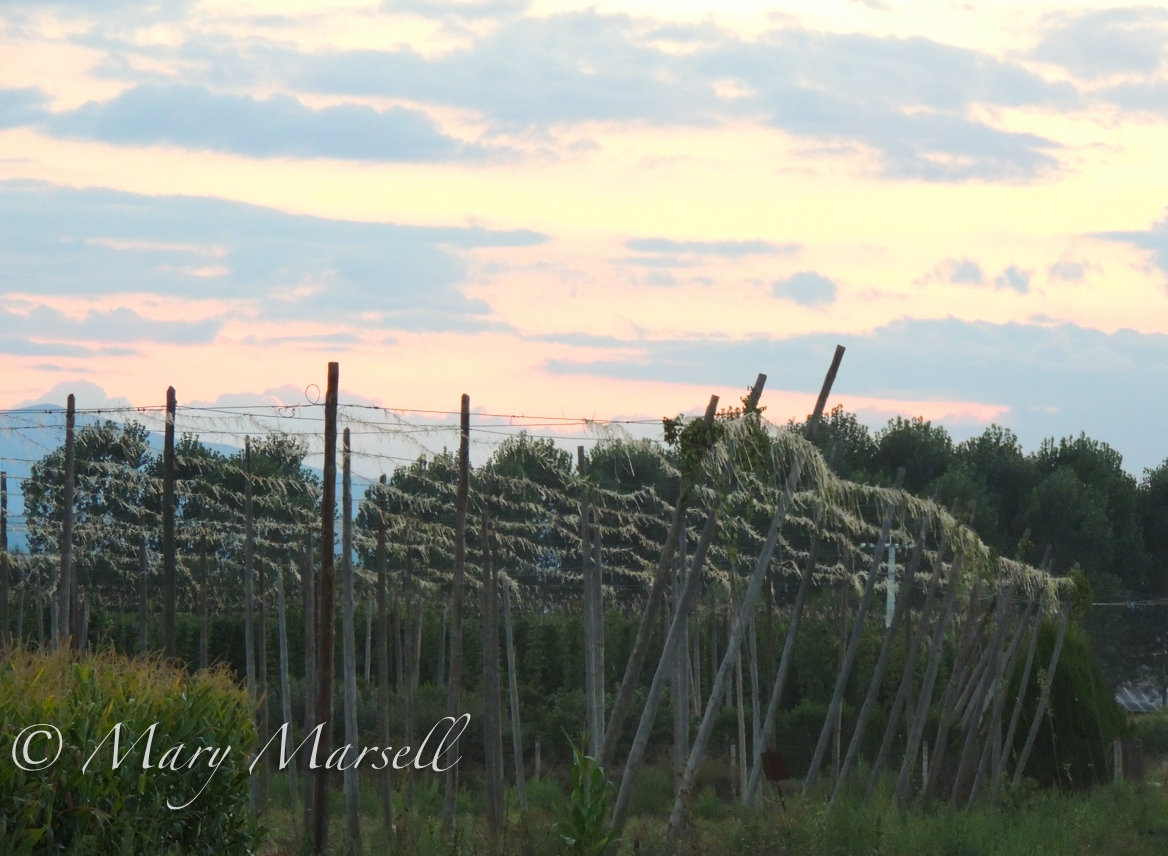
Con lúpulo a la izquierda y la Catedral de Astorga al fondo.
Hops on the left forefront and the Cathedral, Astorga, at the center.
Lúpulo de Otoño y el Sabueso del Cielo

Noventa y nueve por ciento de todo el lúpulo para la producción de cerveza crece en esta provincia de León. España es el cuarto productor de cerveza en Europa después de Alemania, Reino Unido y Polonia, pero es el mayor productor ya que las compañías alemanas dependen del lúpulo español importado para la mayoría de su producción.

Ninety-nine% of all hops for beer production are grown in our province, León. Spain is the fourth largest beer producer in Europe after Germany, the UK and Poland, but is the biggest grower since German beer companies rely on these Spanish hops imported for the majority of their production.


Estos días de otoño, primero templados, luego fresquines, se extienden hasta los largos meses de invierno, cuando la lectura llega a ser más constante y con mayor intensidad. Una de esas lecturas me recordó una expresión que había oído tanto que pensaba que tenía que ser un versículo bíblico.
Descubrí, sin embargo, que el "sabueso del cielo" es el título de un poema de 182 versos  del irlandés, Francis Thompson, por el que se hizo famoso.

Fotos acompañadas con la interpretación moderna en inglés.  

These fall days, first warm, then chilly, stretch long into the long winter months, when reading becomes more constant and with deeper intensity. One such reading reminded me of a term I'd heard so often that I thought it must be a Bible verse.
I discovered, however, that the "hound of heaven" is from the 182-line poem by the Englishman Francis Thompson, for which he became famous.
Photos and The Hound of Heaven, modern interpretation.

Las plantas trepadoras del lúpulo repletas de flores listas para ser recogidas en septiembre. 

He followed me peacefully and swiftly, yet unhurriedly.
He told me, “all people who betray you, betray Me.” (John 15:18-19
If the world hates you, realize that it hated me first.
If you belonged to the world, the world would love its own;
but because you do not belong to the world, and I have chosen you out of the world, the world hates you.) I kept trying to get away from God.
Though I knew of His love for me,
I feared that if I had Him,
I would have to give up everything else.


I kept running across the ends of the universe.
I wanted to hide from this tremendous Lover.
I even tried to hide in the sky.
I tried to tempt the God’s servants to help me hide from God, but they were on His side.
I realized my own sinfulness next to their faithfulness.
So I tried to find another fast way to flee from God.
I clung to the wind.
But no matter where the wind took me, God continued to follow, peacefully and swiftly, yet unhurriedly.

Las flores verdes del lúpulo que sirven para hacer cerveza.

He said, “Nothing shelters you that will not shelter me.”
I stopped trying to flee from God through adults, and began through children, because they will innocently and naively help me.
It just as they started to help, their guardian angels took them away from me.
So then I turned to the beauty of nature to find my happiness.
I enjoyed sharing my experiences of happiness and sadness and all the other emotions with nature.
But even this experience of nature could not ease my human pain.

Una montaña de trepas en camino a la peladora.

I cried to Heaven but there was a language barrier.
I speak through sound. Heaven speaks through silence.
Nature cannot satisfy my thirst.
I am thirsty still. God continues to follow, peacefully and swiftly, yet unhurriedly.
He said, “Nothing contents you that doesn’t content me.”
I have nothing left that will allow me to exist without God in my life, and I have been driven to my knees. I am at rock bottom. I tried everything.
I wait for the love of God.
Everything else, all other dreams, have failed.


The earth is overloaded with heavy sadness.
God, must you break me down before you can use me for Your glory?
My heart is broken. What is to happen?


Everything is bitter, yet now and then a trumpet sounds.
The trumpet sounds from Heaven, but not before the death and resurrection of Christ.
God, must Your glory come from this rotten death? Now from this long pursuit of happiness comes God.


Las trepas peladas. Las flores han sido retiradas para ser secadas y luego utilizadas.

God says, “You keep running from Me. This is strange.
Why do you run from Me? I love you.
You didn’t do anything to merit My love.
Human love is different from My love.
For human love you need merit.
I love you no matter what you do because I Am Love.
I have prepared a place for you with all of the desires of your heart.
I am what you have been seeking this whole time. Psalm 37:4


Find your delight in the LORD who will give you your heart’s desire. John 14: 1-4
Do not let your hearts be troubled.
You have faith in God; have faith also in me.
In my Father’s house there are many dwelling places.
If there were not, would I have told you that I am going to prepare a place for you?
And if I go and prepare a place for you, I will come back again and take you to myself, so that where I am you also may be.
Where I am going you know the way.


Psalm 139: 1-15 O LORD, you have probed me, you know me: you know when I sit and stand; you understand my thoughts from afar.
My travels and my rest you mark; with all my ways you are familiar.
Even before a word is on my tongue, LORD, you know it all. Behind and before you encircle me and rest your hand upon me.
Such knowledge is beyond me, far too lofty for me to reach.
Where can I hide from your spirit? From your presence, where can I flee?
If I ascend to the heavens, you are there; if I lie down in Sheol, you are there too.
If I fly with the wings of dawn and alight beyond the sea, Even there your hand will guide me, your right hand hold me fast.


If I say, “Surely darkness shall hide me, and night shall be my light”
Darkness is not dark for you, and night shines as the day.
Darkness and light are but one.
You formed my inmost being; you knit me in my mother’s womb.
I praise you, so wonderfully you made me; wonderful are your works!
My very self you knew; my bones were not hidden from you, When I was being made in secret, fashioned as in the depths of the earth.

“My heart is restless until it rests in You.” -St. Augustine


The Hound of Heaven  original
That His Pursuit of our Souls
May be Swift and Brief


It is happiness the human soul is ever yearning for. It never stops its quest for happiness. Night and day, year after year, it is grasps after happiness. Our days are long and we are weary. We endure our work to gain the wealth we think may buy rest and happiness. The days we suffer and are in pain (because no one is spared pain in this life) we try to be positive and wait for the agony (loneliness, sickness, death, betrayal...the list is so long) to pass, so we can finally be happy.

We look for happiness in nature; in every creature, in the earth, in the sea, in the air. Our soul asks nature where she finds her happiness. It asks all the creatures and the creation why they are glad and they answer, "God made us." 'We are for Him, for His glory."

So our soul, looking for happiness will not find happiness in the creation. Nature and all these things are not the source. It will find happiness only in God. And yet, instead of seeking happiness in God, we turn away from Him and continue to seek it somewhere, in someone, something; anything that isn't God.
But, God, in His incredible goodness never stops seeking our runaway souls, no matter how much we run away from Him. Wherever we run, we hear the sound of His feet following, and a His voice, stronger than the beat of His feet — But, without hurry, with an even pace; deliberate speed, majestic wisdom. The beat of His footsteps and His Voice calls to us, "All things betray thee, who betrays Me." It's true, all other things are just images of Him. If we love only a reflection we will be betrayed in the end. All the while we are running from Him who loves us true. And this is the image of the greatest love; God's never tiring of us and his relentless pursuing of us even as we run every which way but toward Him.